


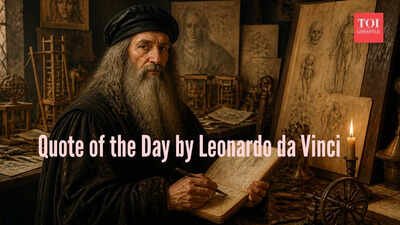
Quote of the Day by Leonardo da Vinci “There are three classes of people: those who see, those who see when…”
Leonardo da Vinci was far more than an artist. He was a visionary, extending the boundaries of art, science, mathematics, engineering, anatomy, architecture and philosophy in an age when most people concentrated on just one discipline. Leonardo lived in the 15th century and had an enormous curiosity about the world. He questioned nature. He studied the human body. He looked at the movement of water. He imagined flying machines. He made some of the most celebrated works of art in history.Leonardo is often cited as the archetypal Renaissance man and inspires generations even today, not just for what he created, but because his genius extended beyond that. It was mirrored equally in his thinking, observation and approach to the world. His life showed that creativity and scientific inquiry were not opposing forces but two expressions of the same human curiosity.Leonardo di ser Piero da Vinci was born on April 15, 1452 in the little Italian town of Vinci, near Florence. He was the illegitimate child of Ser Piero, a notary, and Caterina, a woman of humble origin. Leonardo, though not given the usual education that children of rich families were given, had an extraordinary curiosity about the natural world.As a boy he loved plants, animals, landscapes, water, light, and the movement of living things. He wanted to know why birds could fly, how rivers flowed and what made the human body tick. Eventually his curiosity led him to Florence, one of the most important centers of art and intellectual activity in the Renaissance. He was apprenticed to Andrea del Verrocchio, a respected painter, sculptor and craftsman, at the age of 14 or 15.There Leonardo learned painting and drawing, sculpture, metalworking and engineering. One of his most famous innovations was sfumato, a technique of soft, hazy outlines, achieved by subtle transitions between colors and tones. exquisite delicacy. His most famous painting, Mona Lisa, is known throughout the world for its enigmatic smile, complex landscape and incredible attention to detail. The mysterious smile of the subject has fascinated art lovers and historians for centuries.Another masterpiece is The Last Supper which shows Jesus Christ having his last meal with his disciples. Leonardo depicted the various reactions of the disciples to Christ’s announcement that one of them would betray him. What makes this painting remarkable is especially its composition, psychological depth and storytelling.His other important works are the Virgin of the Rocks and the Lady with an Ermine. With these paintings Leonardo took art to a powerful study of human emotion, personality, and the natural world.The scientist who wanted to know everythingIn one other way Leonardo was unique, for he never separated art and science. He believed that one had to understand nature to be able to portray it truthfully. He studied the human body- looking at muscles, bones, organs and how the body was structured. His anatomical drawings were incredibly detailed, showing an understanding of human physiology that was far ahead of much of the knowledge of his time.His famous drawing Vitruvian Man shows the proportions of the human body within a circle and a square. It is a drawing after the writings of the ancient Roman architect Vitruvius and demonstrates the Renaissance belief that the human body was a mirror of mathematical harmony and proportion.Leonardo also studied botany, geology, optics, astronomy, hydrodynamics and the mechanics of motion. He studied the play of light on objects, the cast of shadows and patterns made by running water. His notebooks are filled with thousands of pages of observations, sketches and scientific ideas. They show a mind that never accepted conventional wisdom at face value but sought to explain by direct observation and experimentation.The inventor of ideas that were decades ahead of their timeLeonardo’s imagination was not limited to painting and anatomy. He invented machines and mechanical devices that presaged technologies developed centuries later. He sketched out flying machines based on the flight of birds, an armored fighting vehicle much like a tank, mechanical gears, bridges, hydraulic systems, and devices for lifting and moving heavy objects.He also concerned himself with the problem of human flight, investigating the mechanics of air resistance and wing movement.Be aware that not all the machines Leonardo sketched were invented by him and not all of his designs worked as intended. What he really contributed was a systematic way of thinking about mechanical principles and imagining new uses for them.His doctrine: The power of observationPerhaps Leonardo’s greatest contribution was his way of learning. He was of the opinion that knowledge starts with observation. He didn’t accept the accepted explanations; he preferred to see for himself. He studied the flight of birds, the flow of water, the growth of plants and the change of human expression with emotion. He knew that even the smallest details could reveal important truths about the world.His notebooks showed an extraordinary habit of questioning. Not just what happened, but why it happened. This made him one of the most remarkable examples of interdisciplinary thinking in history. He showed that you could be an artist, a scientist, an engineer and a philosopher all in one.His famous observation on three kinds of people -those who see, those who see when they are shown and those who do not see – emphasizes the value of awareness and perception. The precise source of this quote is unclear but the sentiment is consistent with Leonardo’s lifelong championing of observation and independent thought.In his later years, Leonardo traveled extensively between several Italian cities, working for powerful patrons and pursuing his studies. In 1516 he was called by King Francis I of France and taken to the Château du Clos Lucé near Amboise. In his last years he lived in France, where he continued to work on his ideas, artistic projects. Leonardo died on 2 May 1519, at the age of 67.He left an amazing legacy of paintings, drawings, manuscripts, and scientific observations. Many of his notebooks were lost after his death, but those that survived are now very important documents for his intellectual accomplishments.Leonardo da Vinci’s influence is not limited to the art world. He changed the way people understood the relationship between creativity, science and observation. Leonardo da Vinci was an artist par excellence-he was a name which shines through the environs of history in the brightest hues.Quote of the Day“There are three classes of people: those who see, those who see when they are shown, those who do not see” It is one of the most profound lines by the iconic artist. According to him, there are majorly 3 types of people in this world. Some people are naturally observant, some need a bit of instruction to see the obvious, and some are oblivious even when the truth is shown to them.The first category, those who see, refers to people with extraordinary observation and awareness. They don’t need someone to explain things for them or draw their attention toward something important. They can see beyond the obvious, recognize patterns, question accepted beliefs and see possibilities where there are none. They are people who are naturally curious and perceptive. They notice the small details, they connect disparate events and often predict consequences before they happen. It is a trait that is often found in great thinkers, innovators, artists and leaders. They don’t just look at the world they see it, they question it, they find meanings that may be missed by the rest of us.The second category, those who see when shown, are people who are receptive to learning. They may not immediately recognize an opportunity or understand a problem or notice something significant, but once someone shows it to them, they can understand its significance. They benefit from education, experience, mentorship and exposure to diverse perspectives. There is nothing inherently inferior about being in this category. And the willingness to learn, to accept new information, to change one’s understanding is in fact an important quality. There is great insight gained by many people over time, because they remain teachable.The third one, the sightless, is perhaps the most thought-provoking. It means people who are still unwilling or unable to see the truth when it is put right in front of them. They may not be able to see due to prejudice, closed thinking, ego, fear or an unwillingness to question their present beliefs. People sometimes become so attached to their opinions that they will not accept evidence that goes against them. They may see the same situation as everybody else, but not know what it means.The deeper meaning of this quote is that seeing is not just a physical process. It is an intellectual and emotional ability. Two people can observe the same event, read the same information, or experience the same opportunity, but they may interpret it in very different ways. They are distinguished by their curiosity, awareness and willingness to think beyond the immediate present.Also the quote makes us think about what category we are in. Do we have the insight to see things for ourselves? Are we willing to learn when we are given a different perspective? Or do we allow our own assumptions and prejudices to blind us to the truth?The biggest lesson of all? Intelligence isn’t just about collecting knowledge. It’s about learning how to see, question, understand and become open to new possibilities. A really insightful person does not wait for the world to point things out. Curiosity to find what others have not yet seen. Humility to acknowledge what they might have missed.