

Trump effect: US-based Indian techies are returning, but to what? Harsh reality of steep salary cuts


US President Donald Trump’s immigration and visa crackdown, AI-led layoffs in the technology sector and rising uncertainty on H-1B visas and green card backlog is prompting a hoard of Indians to return.But, life is not that rosy for these returnees in India. Professionals who have spent years working in the US are finding it difficult to secure comparable roles, match their previous salaries or negotiate compensation that reflects their overseas experience.Employers in India are also increasingly looking for specialised skills rather than treating international work experience as an advantage in itself.So, the important question then is: what are these techies returning to? Are there enough roles to absorb their talent? And, what about the salary levels?
How many have returned?
Data from Xpheno, a specialist staffing firm, shared with TOI suggests that in 2026, so far 12,900 professionals have returned. In 2025, 15,100 techies returned to India in the whole year. The number of people who are moving to the US has also taken a hit. In 2025 it stood at 21,200, but in 2026 so far only 14,800 have moved. If this trend continues, the number of returnees may exceed the count of talent moving to the US.Importantly, industry experts see this trend continuing into the next year as well, particularly with uncertainty around US immigration policies and the growing opportunities in India’s technology ecosystem.Kamal Karanth, co-founder, Xpheno explains why the trend is likely to continue: Given the continuing challenges and developments around talent relevant programs & schemes like H1B, PERM and OPT, the return of US-based Indian techies will likely continue for the near-future.
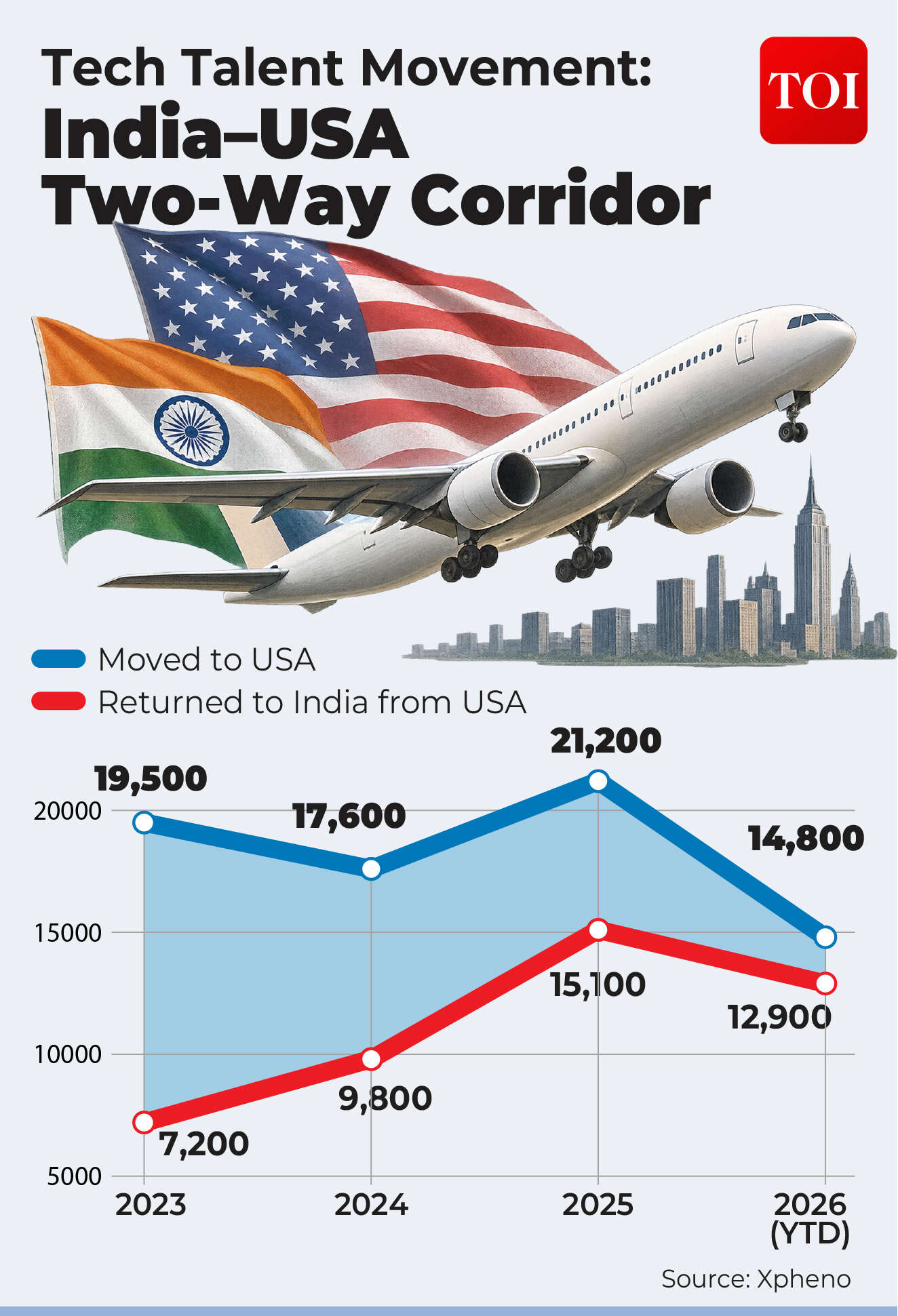
Tech Talent Movement: How many have moved to US and how many techies have returned?
“The current trajectory of tech talent movement between India and US is set on a path where this year’s returnees count will exceed previous year’s count. It will not be surprising if H-1B linked developments drive the returnees count to surpass the count of outbound tech talent from India to the US. It is quite possible that we’ll witness the first net positive year on the India-US talent corridor, where we gain more tech talent from the US than what we lose to them,” he tells TOI.However, Neeti Sharma, CEO, TeamLease Digital says this is not a reversal of talent movement.“People will continue to move in both directions. What we are seeing is a gradual rebalancing, with India becoming an increasingly attractive destination for experienced technology professionals,” she tells TOI.“With GCCs taking on product ownership, AI development and global technology mandates, professionals now have more compelling reasons to build their careers here,” she adds.
What are the roles US tech returnees are getting in India?
Techies returning from the US are getting into a wide range of tech and techno-functional roles across the board.According to Xpheno, some of the top roles the returnees have been getting into include: Software engineers, Senior software engineers, Project & program manager, Data engineers, Data analysts, Technical architects & consultants, Full stack engineers, DevOps specialists.
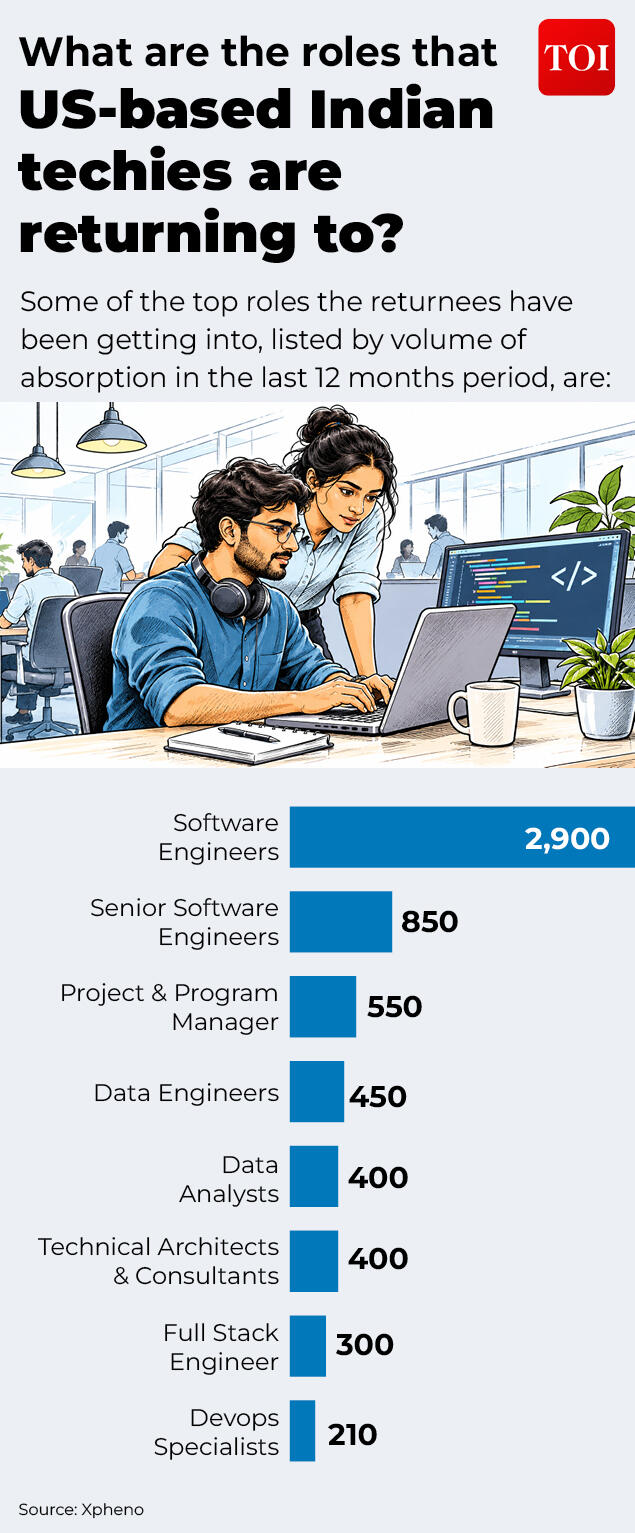
What are the roles that US-based Indian techies are returning to?
Experts see a lot of interest in AI engineering, cloud, product development and technology leadership roles.Neeti Sharma of TeamLease Digital says that companies in India are increasingly giving people the responsibility to build products, own platforms and drive technology decisions.“In the US, many professionals may have been working in specialised roles within larger global teams. In India, particularly in GCCs, they are getting an opportunity to take on larger responsibilities and own outcomes end to end,” she says.According to Sharma, close to 2500 senior returnees from the US have been absorbed within the GCC segment. Nearly 44% of GCCs now have ownership of platforms, products, AI adoption and business-critical functions. This is changing the nature of technology jobs in India.
The stark difference in salary levels
But, the flood of talent returning to India is faced with a harsh reality. Salary figures in India are not as fat. This means settling for a job that pays far less than the one in the US.According to Kamal Karanth, salary packages vary widely based on multiple factors like enterprise context, role, location, pedigree of talent, scope of mandate, enterprise urgency, client-fit quotient etc.In fact, he believes that gone are the days when a US-returned tag would command a premium.“At an enterprise level conscious efforts are deployed to maintain parity in packages at a role, location and experience level. There are no special top up packages offered to returnees purely on grounds of geographic exposure anymore. If anything, the role’s definition, scope of output and performance parameters may be elevated to go with a higher package,” he tells TOI.Kamal Karanth shares an illustration of the difference in a returnee’s US package versus Indian package:
- A Full Stack engineer on H-1B would be in the $70,000 to $150,000 per annum range, with $150,000 being the maximum pay set for outliers.
- The average annual pay for this role and experience level on H-1B is $105,000 (Rs 1 crore equivalent).
- The annual package range for the same talent in India is in the $20,000 (Rs 19 lakh) to $32,000 (Rs 30 lakh) range for the Top 1% percentile by skill and experience level.
The stark difference in salary levels is evident.“The returning talent, at the top 1 percentile, would have to prepare to accept offers at 1/3 or 1/4th their US equivalent value,” he says.Karanth believes that the friction point is often the steep package expectations the returning talent comes with.“Returnees expecting local compensation packages equivalent to their US packages find it difficult or impossible to engage on potential opportunities in India. Returnees whose package expectations are moderated to the Indian employer’s bandwidth & budget stand a better chance of being picked from the hiring funnel. Employers in India no longer bend backwards to match overseas packages to attract overseas or returnee talent,” he says.Neeti Sharma on the other hand believes that some roles can still command a premium.“Within India, specialised technology roles, particularly AI, cloud and cybersecurity, command a significant premium. Broadly, in GCCs, entry-level salaries range from Rs 6-12 lakhs annually, mid-level roles from Rs 18-35 lakhs annually, and senior positions from Rs 45-90 lakhs annually,” she says.Leadership and niche AI roles can go much higher.“For someone returning from the US, the expectation has to be aligned with the Indian market. The opportunity is not necessarily to match US salaries, but to get a larger role, greater ownership and the opportunity to build something in India,” she says.
What does the trend mean for India’s IT sector and existing talent base?
The trend is a positive one for the Indian IT sector, but the existing talent pool in India will face higher competition for the same jobs.“Rise in techies returning, especially from advanced & market defining geographies like the US, is a direct positive enrichment of India’s tech sector. For a sector whose raw material is manpower, the addition of experienced talent exposed to and trained in key client markets is a fast track to further sophistication, with global outlook and elevated capabilities,” says Kamal Karanth.Such returnee talent also often brings along expertise in new and emerging tech stacks and frameworks that can move enterprise services further up the value-chain.The job competition for local talent in India escalates when returnees calibrate their package expectations to local scales.“Returnees available on local packages are a strong competition and contenders for a role, as their profile and pedigree offer more value per dollar on ROI terms. In the new emerging GCCs focused verticals and tailored services from Indian IT Services, returnee expats have a definite edge compared to their local counterparts,” Karanth believes.From the growth prospects of the IT sector, people returning from the US bring experience of working on global products, managing large teams and handling complex technology programmes. This adds to the depth of leadership and specialised talent available in India.However, Neeti Sharma points out that the market is selective.“Companies are looking for specific skills and relevant experience, not just international exposure. AI, cloud, product engineering and cybersecurity are areas where demand is particularly strong,” she says.“For professionals already in India, there will be more competition, especially at the mid and senior levels. But it also raises the bar for the entire talent pool. India’s technology workforce will benefit from this exchange of experience, and the need to continuously upgrade skills will become even more important,” she adds.