

SpaceX IPO this week: From listing date to valuation, 10 things to know before Elon Musk’s firm goes public
SpaceX is preparing for a stock market debut that could become the largest initial public offering in history. The Elon Musk-led company is seeking to raise about $75 billion at a valuation of roughly $1.75 trillion, a figure that would place it among the most valuable publicly traded companies in the world from day one.The offering has already attracted significant investor interest, with reports suggesting demand has exceeded the shares currently available. The IPO is also unusual because of the sizeable allocation expected for retail investors and the company’s decision to publicly disclose an intended share price before the traditional pricing process is completed. At the same time, investors are weighing questions around valuation, profitability and corporate governance. As SpaceX moves closer to its expected Nasdaq debut on June 12, here are 10 things investors should know about the offering.
Could become the most valued IPO
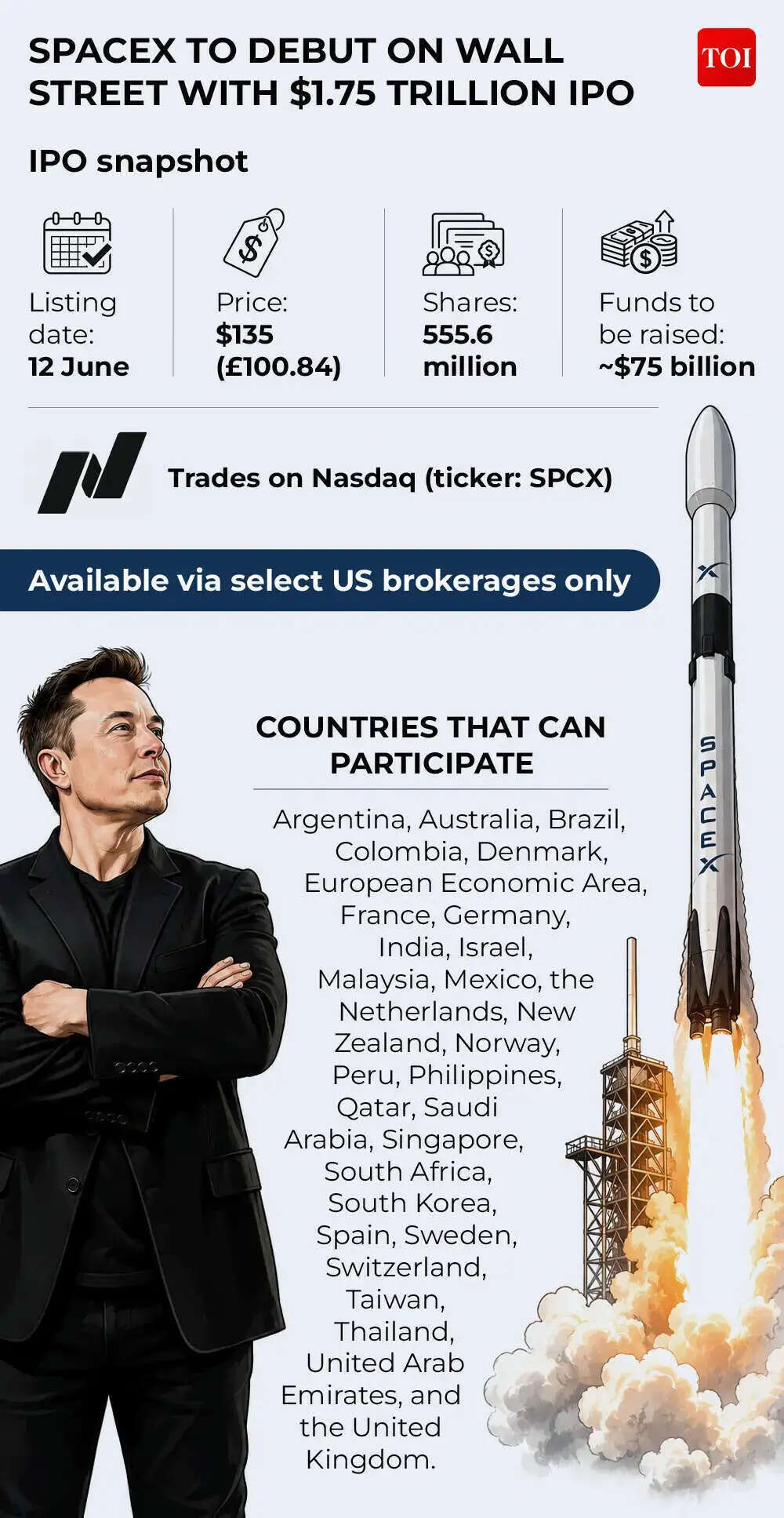
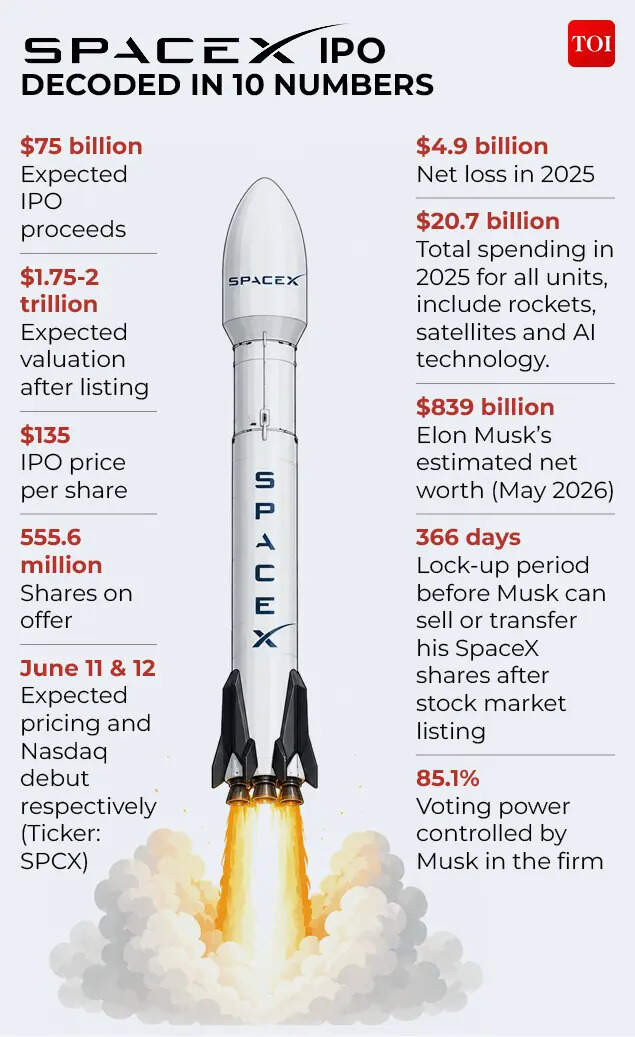
SpaceX is aiming to raise approximately $75 billion through the sale of about 555.6 million shares. At its targeted valuation of roughly $1.75 trillion, the offering would surpass previous record-setting IPOs and become the largest stock market debut ever completed.If the listing proceeds as planned, SpaceX would immediately join the ranks of the most valuable companies trading on US stock exchanges. The IPO is also being closely watched because it could set the tone for other highly valued technology companies considering public listings in the coming months.
Trading this week
SpaceX has publicly indicated a share price of $135 and is expected to formally price the offering on June 11. Trading is expected to begin on Nasdaq on June 12 under the ticker symbol “SPCX”.The company’s approach has attracted attention because major IPOs typically determine their final price only after roadshows and investor consultations have concluded. By signalling its intended valuation early, SpaceX has departed from a long-established Wall Street process.
Investor demand is high
Interest in the IPO has been strong even before pricing. According to reports, investors have expressed interest in purchasing roughly $150 billion worth of shares, about twice the amount SpaceX is seeking to raise, as reported by Reuters recently.Bankers involved in the transaction have described demand as robust throughout the marketing process. While indications of interest can change before final allocations are made, the early response suggests investors are willing to back SpaceX despite its lack of profitability and its premium valuation. The company’s position in commercial launches, satellite communications and emerging AI infrastructure has helped attract interest from both institutional and retail investors.
Retail investors are getting unusually large access
SpaceX is expected to reserve a much larger portion of its IPO for individual investors than is typically seen in major listings. Several media reports suggest as much as 30 per cent of the offering, equivalent to around $22.5 billion worth of shares, could be allocated to retail investors.That compares with the smaller retail allocations often seen in large IPOs, where institutional investors usually dominate the order book. Brokerage platforms including Fidelity, Robinhood, SoFi and E*Trade are among those expected to distribute shares to eligible investors in the United States. The approach could broaden ownership of the company while also tapping into Musk’s large retail investor following.Strong demand means investors may not receive the full number of shares they apply for. In oversubscribed IPOs, allocations are often reduced to accommodate a larger number of investors.The final allocation process will depend on the level of demand and decisions taken by the company and its underwriters. Some investors may receive only a portion of their requested shares, while others may not receive an allocation at all. Those who miss out during the IPO process will still be able to purchase shares once trading begins on the open market, although prices could move significantly after listing.
Indian investors will have a different route
For Indian investors, direct participation in the IPO is likely to be limited. Instead, most investors in India would be expected to gain exposure after the shares begin trading on Nasdaq.Such investments can be made through international brokerage platforms under the Reserve Bank of India’s Liberalised Remittance Scheme, which permits eligible residents to remit up to $250,000 per financial year for overseas investments. India has been listed among jurisdictions where eligible investors may be able to access SpaceX shares, subject to applicable regulations and investment requirements.
SpaceX remains a loss-making company
The excitement surrounding the IPO comes despite the company remaining unprofitable. SpaceX reported revenue of $18.67 billion in 2025, up 33 per cent from the previous year, but also posted a net loss of $4.94 billion.The figures underline the substantial costs associated with rocket launches, satellite deployments and investments in future technologies. In its IPO filings, SpaceX said it does not expect to become profitable in the near term. Investors are therefore being asked to place significant weight on the company’s future growth prospects rather than its current earnings profile.
A new Google agreement has strengthened the growth story
One of the most notable updates to the IPO paperwork was the disclosure of a cloud-services agreement with Google. Under the arrangement, SpaceX is expected to provide large-scale AI computing infrastructure, including approximately 110,000 NVIDIA GPUs and related hardware.The agreement could generate about $29.4 billion in revenue over its term, according to details disclosed in the amended filing. The deal adds a significant recurring revenue stream and has strengthened SpaceX’s efforts to position itself as a participant in the rapidly expanding AI infrastructure market, alongside its existing launch and connectivity businesses.
Elon Musk expected to retain control
The listing is not expected to significantly dilute Musk’s influence over the company. SpaceX’s dual-class share structure gives Class B shares ten votes each, compared with one vote for Class A shares.Musk owns the overwhelming majority of the high-voting stock and is not selling his own shares in the offering. As a result, he is expected to retain dominant voting control even after the company becomes publicly traded. Supporters of such structures argue they help founders pursue long-term strategies, while critics say they reduce accountability to minority shareholders.
Musk could become the world’s first trillionaire
The IPO could further cement Elon Musk’s position as the world’s richest person. Because Musk is not selling shares in the offering and is expected to retain dominant control of the company, any increase in SpaceX’s market value after listing would directly boost his personal wealth.At the proposed valuation of about $1.75 trillion, Musk’s stake is already worth hundreds of billions of dollars. Some analysts have estimated that if SpaceX’s valuation continues to rise in the years ahead, Musk could become the first person in history to amass a net worth of $1 trillion. While such projections depend on future stock performance and the valuation of his other businesses, the IPO is expected to significantly strengthen his financial position and further expand his influence across the technology, space and artificial intelligence sectors.
The valuation remains the biggest debate among investors
Perhaps the most significant question surrounding the IPO is whether SpaceX’s valuation can be justified. At approximately $1.75 trillion, the company is being valued at roughly 90 to 110 times trailing sales despite continuing to report losses.Supporters argue that investors are paying for future growth in satellite communications, launch services, AI infrastructure and other emerging businesses. Critics counter that such expectations leave little room for operational setbacks or slower-than-expected growth. Investors must also weigh risks including launch failures, regulatory changes, increased competition and governance concerns linked to the concentration of voting power.