
Silicon Valley Start-Ups Face a Future Without Jensen Huang’s Money
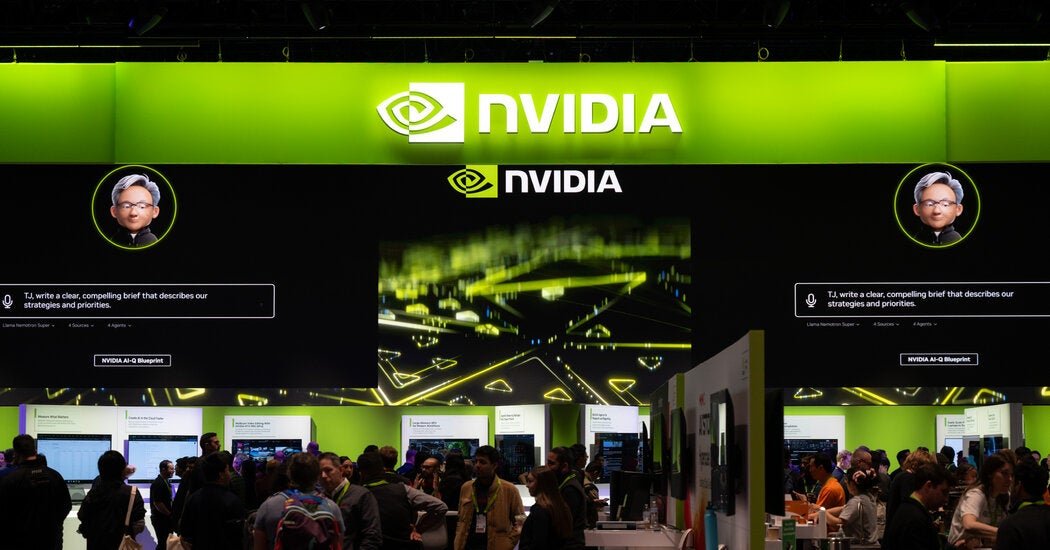
For years, Jensen Huang was a frequent presence at Silicon Valley start-up events, networking with founders, judging pitch competitions and showing up at “demo” days.
The Nvidia chief executive became a godlike figure in the start-up ecosystem, not just because the industry idolized him as one of the world’s most successful entrepreneurs. Mr. Huang, 63, also made it his mission to help start-ups gain a foothold against the industry’s biggest and most powerful tech companies, providing funding and computing power.
“As many good ideas as we have, you don’t have all the world’s good ideas,” he said on the Acquired podcast in 2023.
So Mr. Huang’s abrupt resignation from Nvidia on Thursday has investors and start-up founders nervous that they have lost a powerful ally.
“Nvidia is the central bank of A.I. and all of a sudden, the Fed chairman is out,” said Tomasz Tunguz, an investor at Theory Ventures, which funds young start-ups.
Nvidia held $48 billion worth of stakes in 229 private companies, including large stakes in OpenAI and Anthropic, at the end of July, according to securities filings. It more than doubled its start-up investments in six months.
Perhaps more critically, Nvidia has provided start-ups and small companies with access to A.I. chips that would have been difficult for them to obtain otherwise, offering $165 billion in lease guarantees and other backstops for cloud computing to start-ups and other companies, according to securities filings. The company has a venture capital arm and a program called Inception that provides tens of thousands of start-ups with training and guidance on how to access chips and computing power.
Mr. Huang has also been the industry’s most vocal advocate for “open source” and “open weight” technology, which makes underlying A.I. technology freely available for anyone to use, which benefits start-ups. Nvidia shelled out nearly $20 billion to buy two open source-focused companies in the last year.
Mr. Huang’s departure adds more uncertainty to an already jittery market. Investors fear A.I. is in a bubble that could burst. And the tech industry also faces potential regulation and a slowdown in data center construction ushered in by the results of the midterm elections. Nvidia controls the vast majority of the world’s market for the computer chips that A.I. companies need to build and service their technology.
The change in leadership could make it more difficult for smaller companies to access the chips and cloud computing power they need to compete against well-funded tech giants like Amazon, Google, Meta and Microsoft. More practically, it throws a number of investment deals Nvidia has in the works into limbo.
Mike Volpi, an investor at Hanabi Capital, a venture capital firm that backs A.I. companies, said he expected Nvidia to take a more conservative approach to backstopping so many smaller cloud companies.
“My expectation is that we will see some turbulence and some of Nvidia funds coming out of the market in the short term,” he said.
The A.I. industry relies so much on Nvidia that commentators have started to caution against the risks.
Speaking to a standing-room-only audience of software developers in San Francisco last month before Mr. Huang came under fire, Dylan Patel, who runs SemiAnalysis, an A.I. research firm, warned that struggling young data center companies were having no problem securing revenue guarantees from Nvidia. That allowed the companies to then take on debt they otherwise wouldn’t have gotten.
“This is sort of a quite a risky proposition,” Mr. Patel said. “We’ll see what ends up happening there.”
Mr. Huang’s pro-start-up stance has delivered cash windfalls to venture capital investors over the past year, especially with Nvidia’s purchases of start-ups. The company bought the technology and hired employees from chipmaker Groq for roughly $20 billion last December and the A.I. open-source platform Hugging Face for about $14 billion in September.
“Jensen Huang, we have yet to meet, but bravo!” Joseph T. Hasselmann, a start-up investor who backed Groq, wrote on LinkedIn after the deal was announced.
Samantha Lau, who manages a tech stock portfolio at AllianceBernstein, an investment firm, said Mr. Huang’s exit would probably eliminate a key source of financing for companies like the young data center firms that have been planning public offerings, and dampen overall market enthusiasm.
“The god of circular financing is going into hibernation,” she said, referring to the A.I. industry’s many interconnected deals.
Sujay Jaswa, a partner at Wndr, a venture capital firm that has hosted Mr. Huang as its events, compared his resignation to the death of Steve Jobs.
“It’s a gigantic loss for all of us,” he said.