

India’s ‘looksmaxxing’ economy: More science, more spending, fewer taboos
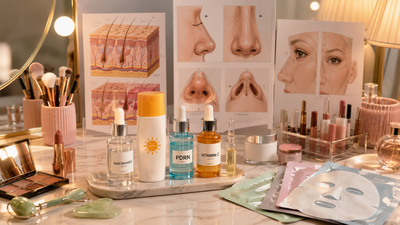
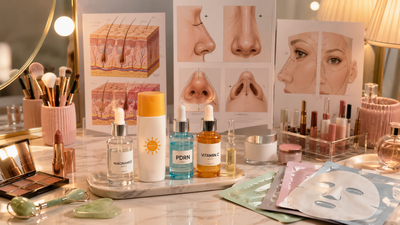
What’s in your latest beauty haul?A PDRN shot? A retinol night cream? Niacinamide foundation tint? Maybe a sunscreen that’s SPF 50 PA++++ because Instagram told you anything less is a crime against your skin.Not too long ago, beauty looked very different. A “12-step skincare routine” would’ve probably lasted… 12 days. A cold cream, talcum powder, compact, kajal and a trusty bottle of coconut oil were enough. A stubborn pimple? Multani mitti. A summer tan? Besan, haldi or milk to the rescue. SPF and skin barriers weren’t everyday conversations.Bathroom shelves now resemble mini science labs, lined with retinol, niacinamide, ceramides, hyaluronic acid and sunscreens with ingredient lists straight out of chemistry textbooks.Somewhere between the cold cream and collagen serum, India didn’t just upgrade its beauty game — it created a new playbook.
From fairness creams to skin wellness
Earlier, the Indian beauty ideal was predictable: fair skin, straight hair, a slim frame and minimal signs of ageing. Beauty routines were simple, usually limited to cleansing, toning and moisturising. Weddings meant facials and bleach at neighbourhood parlours, while cosmetic procedures were discussed quietly.Dermatologists on Instagram are replacing beauty magazines, Korean, Japanese and Moroccan skincare has found a loyal audience, laser treatments are becoming part of wedding preparation, and Botox is no longer a taboo topic.According to Dr. Tanmayi Komal Kumar, consultant dermatologist at SPARSH Hospital, Bengaluru, the shift has largely been driven by changing attitudes and greater awareness.“The concept of beauty in India has changed dramatically within the last ten years due to the change in attitudes toward Eurocentric concepts like whiteness or thinness and focus on skin wellness, balance, and uniqueness,” Kumar told TOI.
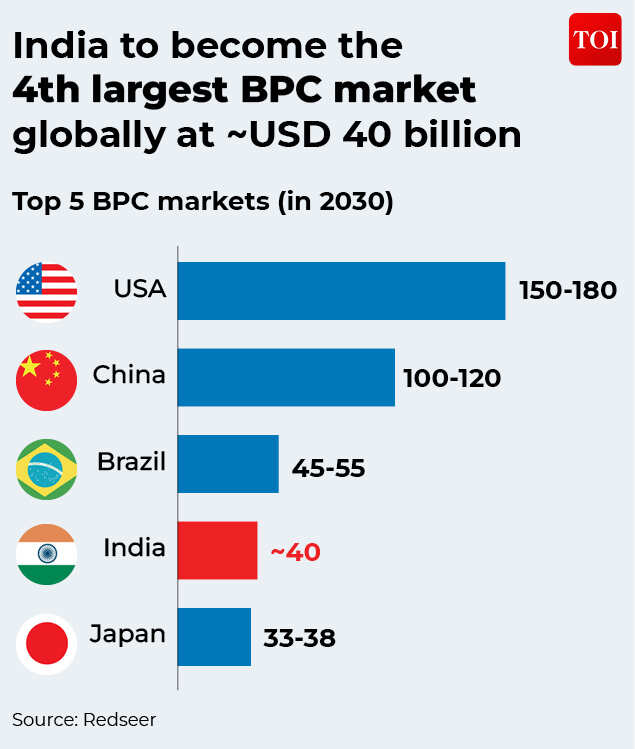
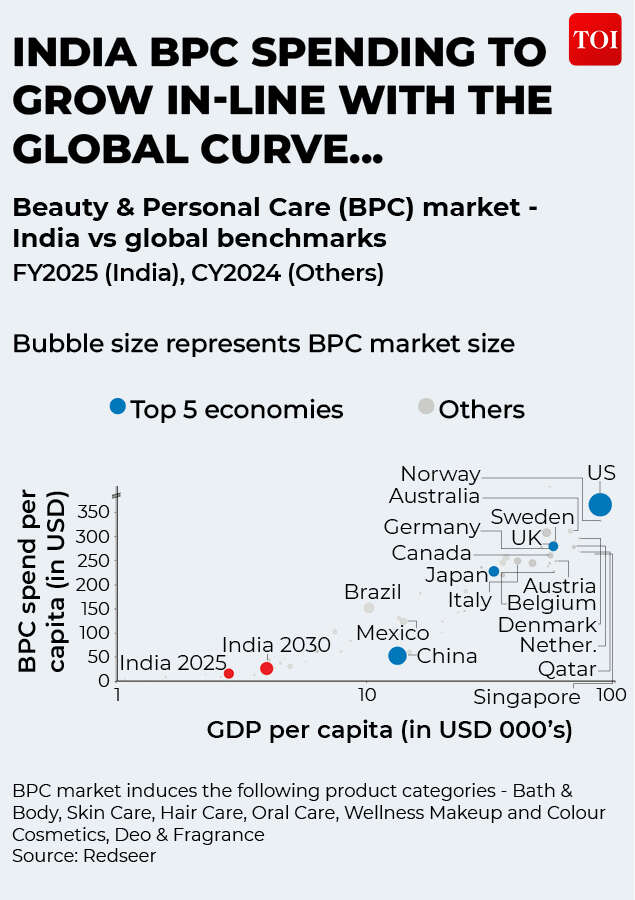
India’s beauty and personal care market, currently valued at around $23 billion, is projected to touch $40 billion by 2030, making it one of the country’s fastest-growing consumer sectors.India is also expected to become the world’s fourth-largest beauty and personal care market. In FY2020, only 8% of beauty purchases happened online. By FY2025, that share climbed to 20%, and by 2030, online channels are expected to account for 34-38% of all beauty spending.
Rise of digital beauty economy
According to industry estimates, around 56% of urban consumers are interested in customised skin and haircare products, while 55% of new beauty customers are coming from Tier-2 and Tier-3 cities. Another 70% of Indian consumers say product reviews on social media and blogs influence what they buy.Influencers explaining skin barriers, dermatologists reviewing sunscreens, creators comparing Korean toners and thousands of “Get Ready With Me” videos have turned skincare into daily entertainment.For decades, beauty consumption was concentrated among urban women. Today, rising incomes, better internet access and direct-to-consumer brands have made premium products accessible to smaller cities.Redseer attributes this momentum to increasing female workforce participation, rising disposable incomes, more than 500 million social media users, over 3 million influencers, and rapid expansion of organised retail and e-commerce.
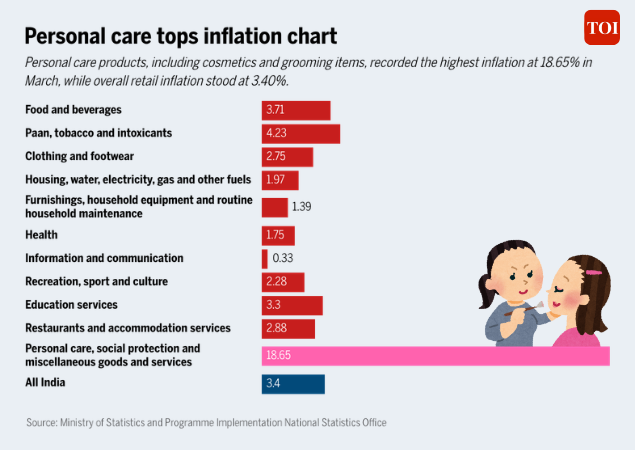
Instead of hiding acne under foundation, consumers talk about repairing the skin barrier. Instead of searching for fairness creams, they compare vitamin C, retinol, ceramides and peptides.
Rise of the ‘tweakments’
A straighter nose, sharper jawline, fuller lips, tighter skin or simply looking more “rested” — India’s beauty wishlist is getting a high-tech upgrade.According to the International Society of Aesthetic Plastic Surgery (ISAPS), India performed 5,31,792 aesthetic surgical procedures in 2023, making it one of the world’s busiest cosmetic surgery markets.The country ranked second globally in rhinoplasty (nose reshaping), third in liposuction, second in non-surgical facial rejuvenation performed by plastic surgeons, and seventh overall in surgical and non-surgical aesthetic procedures. Around 80% of these surgeries were performed on women.The growth is being driven by changing perceptions. Cosmetic procedures are no longer associated only with celebrities or reconstructive medicine. Consumers are increasingly opting for “tweakments” that subtly enhance appearance rather than completely alter it.
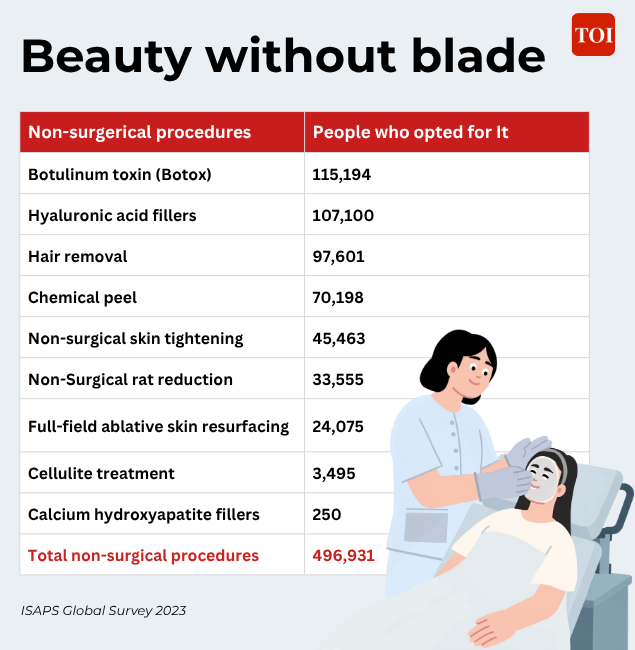
Dr. Kumar says the demand for botox, fillers and aesthetic procedures has grown significantly not only in metro cities but also across Tier-2 India.“The reasons behind this include high disposable income, regular conversations about aesthetics on social networking sites, along with the availability of certified dermatologists and plastic surgeons. In terms of demographics, there has been significant growth in terms of who constitutes this market,” Dr. Kumar told TOI.While millennials and Gen Z in their mid-20s are increasingly asking for “pre-juvenation” — preventive doses of Botox or fillers before wrinkles appear — people in the 30-50 age group largely seek non-invasive procedures to maintain their appearance.
Choosing to stay ‘forever young’
Together, injectables accounted for nearly 14.8 million procedures, making them the largest category of non-surgical aesthetic treatments. Hyaluronic acid procedures alone grew by 29.1% in one year.Meanwhile, in India, liposuction accounted for more than 1.02 lakh procedures in 2023. Rhinoplasty crossed 71,000 procedures, while eyelid surgeries exceeded 40,000.
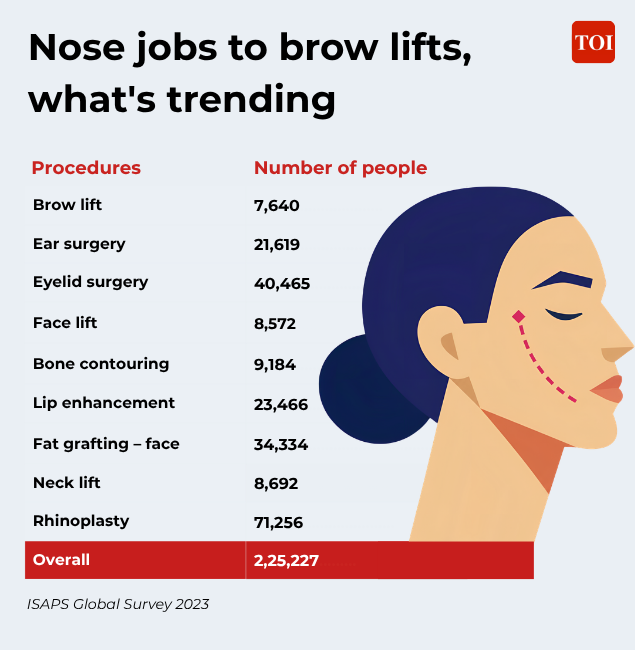
Brides and grooms are no longer the only ones planning aesthetic treatments. Parents, siblings and relatives are also preparing “aesthetic timelines” before weddings, opting for laser toning, skin tightening, fillers and other minimally invasive procedures.“Apart from weddings, another wave of cosmetic surgeries is seen prior to milestone birthday, re-union, vacation, and festive season. The social media culture, where high-resolution photography and video recordings are popular, gives rise to the need for looking good even through camera lenses.”
From macho to moisturised: Beauty for men
“There has been an increase in the number of men seeking treatment from aesthetic clinics in India. Some of the major reasons behind this trend are competition at work, corporate image needs, and the reduced stigma surrounding self-improvement among males.”ISAPS data shows that among men worldwide, the most common surgical procedures include eyelid surgery (3.93 lakh procedures), gynecomastia surgery (3.52 lakh), liposuction (3.39 lakh) and rhinoplasty (2.9 lakh).Dr. Kumar further added, “Men have gone past just undergoing hair transplants and changing their beards and are now seeking anti-wrinkle injections, jaw shaping through fillers, removal of double chin, and under eye treatments. It is usually not about making themselves look better but looking fresh and energized without being too conspicuous about it.”
Party for Botox?
Forget kitty parties, India’s beauty circles now have a new guest list: Botox parties.These gatherings turn wrinkle-smoothing treatments into social events where people get injectables in informal settings.Globally, such practices have become a talking point. Dr. Kumar cautions that Botox parties pose serious medical and ethical risks.“Injection in a party setting or in any other non-clinical environment, usually conducted in association with alcohol consumption, poses a higher chance of errors in technique, infections, and poor hygiene when carrying out the injection. The risks from a medical point of view include vascular occlusion, facial asymmetry, anaphylactic shock, and infection,” Dr. Kumar said.
Beyond face: The shape shifting
Beauty today has no borders. An Indian skincare routine can begin with the Korean obsession for “glass skin”, borrow a Moroccan Neela powder ritual, explore African beauty traditions like black soap, follow Japanese-inspired anti-ageing layering techniques and end with a dermatologist-approved treatment. Powered by social media and influencers, global aesthetics are travelling faster than ever.The global beauty wave is also pushing the industry towards advanced aesthetics, where beauty meets biotechnology. From regenerative treatments and injectables to therapies promising skin repair and hair restoration, the focus is shifting from what is applied on the skin to what happens beneath it.Dr. Geetika Jassal, medical spokesperson at Cryoviva Life Sciences, said global aesthetic trends are rapidly gaining momentum in India, but their adoption must be backed by science, regulation and careful patient selection. “Global aesthetic trends are rapidly gaining momentum in India but their adoption should be guided by scientific evidence, regulatory oversight and careful patient selection. There are risks associated with the off-label use of drugs such as semaglutide (Ozempic) for weight loss,” Jassal told TOI.Another emerging field is exosome therapy, which is being promoted for skin rejuvenation, wound healing and hair restoration. “Exosomes serve as cellular communicators that carry growth factors,” Dr. Jassal explained, adding that early research suggests they may support tissue repair and collagen production, though clinical evidence remains limited.
Where to draw the line
India’s beauty journey has come full circle, from chasing a narrow definition of beauty to creating a more personal and evolving one. What was once shaped by Bollywood stars, beauty pageants and fairness ideals is now influenced by social media, global trends, skincare science and individual choices.As Dr. Kumar said, “It is natural to want to have confidence in oneself; however, the overemphasis on photos that have been edited until they reach perfection on social media platforms may create expectations that are unrealistic and body dysmorphia.”She added that “One needs to know when it is time to draw the line, as the aesthetic procedure stops being something that is done for the well-being of the patient and starts being the pursuit of something impossible to achieve.” She stressed that doctors must “identify possible psychological factors, to set realistic expectations, and to refuse from procedures that are not necessary.”India’s beauty story is no longer about becoming someone else, but what your own version of beauty looks like.