

France vs Paraguay becomes one of hottest World Cup matches ever as extreme heatwave grips Philadelphia city | Football News


France’s FIFA World Cup 2026 Round of 16 meeting with Paraguay has unfolded under some of the most punishing weather conditions ever witnessed at a men’s World Cup, with temperatures approaching 100°F (37.8°C) at kick-off and the heat index climbing as high as 105°F to 110°F (40.6°C to 43.3°C) during the match.As the second half got underway at Philadelphia’s Lincoln Financial Field, France held the advantage after Kylian Mbappé converted a penalty, and that decisive moment ultimately secured victory for Les Bleus, who advanced into the quarter-finals as the second team to do so after Morocco. However, much of the conversation surrounding the fixture has centred on the extraordinary weather conditions that have transformed one of the tournament’s marquee knockout ties into a severe physical test for both teams. The match was played outdoors amid an Extreme Heat Warning issued for Philadelphia, making it one of the hottest World Cup fixtures ever staged.
Philadelphia heat wave pushes players to the limit
The United States has been gripped by an intense heat wave throughout the week, with the northeastern region recording temperatures close to 100°F (37.8°C) since Wednesday. By the time France and Paraguay kicked off at 5 p.m. local time, the official air temperature inside Philadelphia stood between 99°F and 100°F (37.2°C to 37.8°C).Meteorologists had forecast a daytime high of 100°F (37.8°C), only a few degrees below Philadelphia’s Independence Day record of 103°F (39.4°C), set on July 4, 1966. More concerning was the projected heat index, which combined temperature and humidity to create conditions that felt between 105°F and 110°F (40.6°C to 43.3°C), levels at which health authorities advise even elite athletes to avoid prolonged outdoor activity.

France’s Kylian Mbappe (10) wrings out a towel during a hydration break in the World Cup round of 16 soccer match between Paraguay and France in Philadelphia, Saturday, July 4, 2026. (AP Photo/Matt Slocum)
The National Weather Service had already placed Philadelphia under an Extreme Heat Warning until 8 p.m., meaning the majority of the knockout fixture would be played during the most oppressive part of the day. Weather forecasters also warned that the threat of thunderstorms would increase as the match progressed.
Among the hottest World Cup matches ever played
The Round of 16 encounter has immediately entered World Cup history because of the weather.With kick-off temperatures hovering around 100°F (37.8°C), France versus Paraguay ranks among the hottest matches ever played at a men’s FIFA World Cup and is the hottest fixture of the 2026 tournament so far.Only a handful of World Cup matches have been played in comparable conditions. The most extreme example came during the 1994 World Cup in the United States when Mexico faced Ireland in Orlando, where temperatures reportedly exceeded 110°F (43.3°C), making it the hottest World Cup match on record.That places Saturday’s clash in Philadelphia among the most physically demanding contests the tournament has ever witnessed.
FIFA keeps original kick-off despite weather concerns
Despite the forecast, FIFA chose not to delay the match into the evening.The governing body had previously explored adjusting kick-off times for several knockout fixtures, including Brazil versus Norway and Mexico versus England, but ultimately decided against making schedule changes.Unlike those fixtures, France’s meeting with Paraguay did not clash with any other Round of 16 game. Canada’s earlier match against Morocco had already been completed in Houston, meaning the schedule would have allowed for a later start had FIFA chosen to move the fixture.
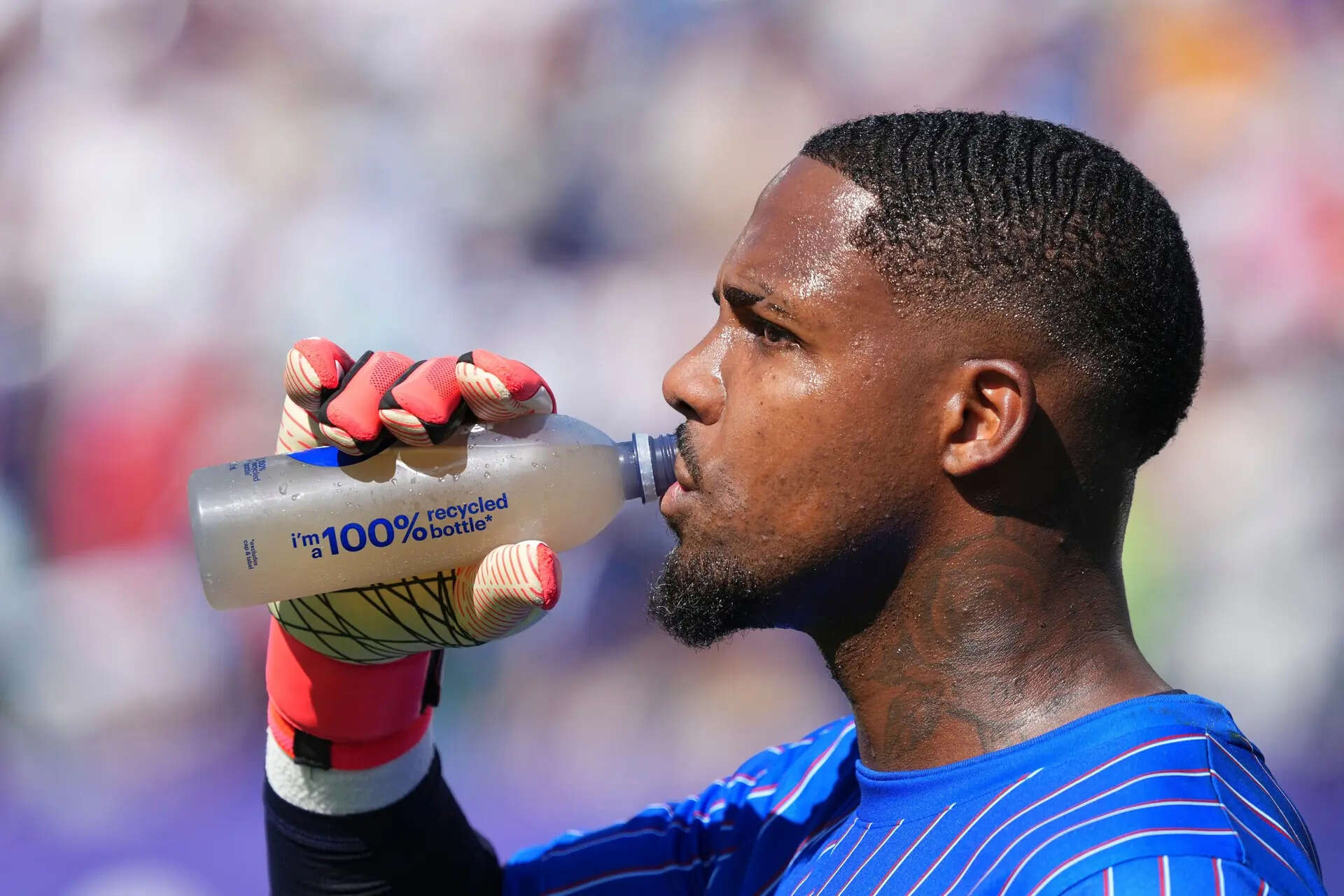
France goalkeeper Mike Maignan (16) drinks water ahead of the World Cup round of 16 soccer match between Paraguay and France in Philadelphia, Saturday, July 4, 2026. (AP Photo/Martin Meissner)
Instead, organisers introduced temporary cooling measures around the team benches. Portable air-conditioning units were installed to provide players and coaching staff with relief during breaks in play, while the scheduled cooling breaks assumed even greater importance under the extreme conditions.The global players’ union, FIFPro, recommends mandatory cooling breaks once temperatures exceed 86°F (30°C) and advises that matches should be delayed or postponed when conditions rise above 96°F (35.6°C). Saturday’s temperatures comfortably surpassed both thresholds.
Paraguay embrace the heat as France adapt
The conditions appeared to suit Paraguay more naturally than their European opponents.Speaking before kick-off, Paraguay manager Gustavo Alfaro said the weather was “very similar to what we have in Asunción,” while defender Júnior Alonso joked: “Hopefully it will get a little warmer tomorrow.” He also described the conditions as “completely normal for us.”

Players of Paraguay drink water during a hydration break, during the World Cup round of 16 soccer match against France in Philadelphia, Saturday, July 4, 2026. (AP Photo/Matt Rourke)
France entered the match with recent experience of high temperatures after playing in approximately 90°F (32.2°C) conditions during their previous victory over Sweden in New Jersey. Head coach Didier Deschamps acknowledged the challenge but expressed confidence in the team’s preparation.“It’s not ideal,” Deschamps said. “But I’m not too worried about the heat. Together with the medical staff, we’ve made sure that various measures have been put in place.”