


A Curiosity Shop in Paris Offers Unusual Gift Ideas
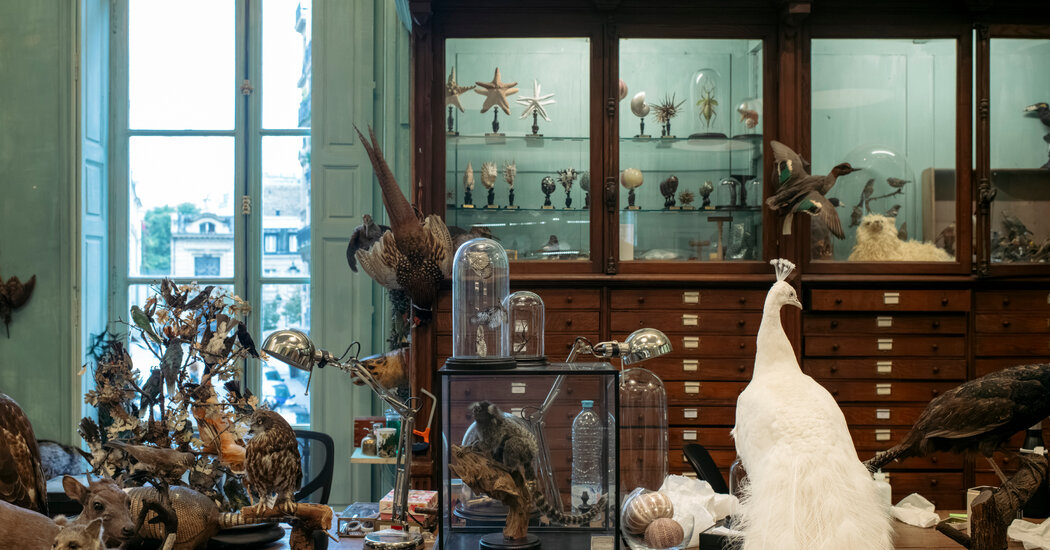
One recent overcast morning, four women from California were exclaiming over the iridescent shells, colorful corals and crustaceans, suspended mid-crawl, on display in some cabinets at Deyrolle, the historic taxidermy gallery and scientific institution in Paris.
“I feel like when I’ve gone to natural history museums,” one of them said to her friends. “But what do they have on this?”
Planning to leave with gifts, the women had no shortage of options. Items for sale included diodons, nicknamed balloonfishes or sea hedgehogs, several of which hung from the store’s large brass chandelier (each 40 euros, or $47); fossilized shark’s teeth (€2 each); meteorite shards from Mars (€45 each); a two-meter, or 6.5-foot, taxidermied polar bear (€40,000); and a rare 30-million-year-old oddly shaped sandstone concretion called a gogotte (€3,000).
Founded in 1831 by Jean-Baptiste Deyrolle, formerly a taxidermist at a natural sciences museum in Brussels, the business initially supplied specimens to museums and private collectors. Successive generations of Deyrolles — a dedicated band of naturalists, explorers and entrepreneurs — expanded its scope, publishing educational works, producing scientific and pedagogical models and instruments and introducing a celebrated series of illustrated posters, once familiar to school children around the globe.
By 2000, however, the business was in severe financial difficulty, and Louis Albert de Broglie, a French entrepreneur, conservationist and former investment banker, decided to buy it.
Mr. de Broglie, whose family has held a princely title since 1757, said he has emphasized what he called Deyrolle’s “three pillars”: nature, art and education.
Along with reviving Deyrolle’s publishing activities and mounting regular exhibitions, the business has collaborated with such ecologically minded partners as UNESCO, helped to design a giant panda park and breeding facility in Chengdu, China, and produced an updated poster series called Deyrolle for the Future, on topics such as marine mammals and wind energy.
“You cannot protect, preserve and transmit” the natural world and its animals unless you study them, Mr. de Broglie said. (In recognition of the house’s wide-ranging expertise, the French government designated Deyrolle as a Living Heritage Company in 2013.)
The company also stresses that it operates in strict compliance with the Convention on International Trade in Endangered Species, the global treaty known as CITES, and that all of the animals it sells died of natural causes in zoos, parks and farms.
In addition to its store stock, Deyrolle also has a website that will ship items such as an emu egg (€90); a botanical print of Le Fraisier, or the strawberry, suitable for framing (€35); a small taxidermied lamb (€2,200); or a signed print of “Paciderm,” a drawing by Johnny Depp produced in a 250-piece limited edition (€1,740, half of which goes to an art charity). In connection with the project, Mr. Depp gave the business a statement in March that called Deyrolle “a place that celebrates the strange, the beautiful and the often-overlooked wonders of nature.”
But by highlighting nature’s splendor, Mr. de Broglie said, Deyrolle is preparing both young and old “to see the beauty of the world.”
Nowhere is that more evident than in its large, wood-paneled entomology room.
Here, “there’s a little bit of everything,” said Ameline Galle, 27, whose work includes identifying, restoring and mounting insects, as well as answering the legion of questions posed by inquisitive children visiting the store.
Walking along a long row of wooden cabinets topped with display boxes, she pointed to various specimens beneath the glass: gold and silver beetles, spiders, scorpions, cicadas, plant hoppers, a giant devil’s flower mantis, dragonflies, bees and crickets.
Most popular with customers, she said, are the butterflies. Sold singly or by the dozen, they may be displayed in entomological boxes or bell jars and arranged in monochromatic clouds or long multicolored flights (€30 to more than €8,000). “At Deyrolle, anything is possible,” she said.
Not all are for sale, however. Some, she said, come from museums and heirloom collections to be restored; those that are sold usually have come from breeding farms that conserve their natural habitats. “They come wrapped in paper folds,” said Ms. Galle, who opened a large triangular envelope of glassine, a semitranslucent paper used because its smooth surface doesn’t damage delicate specimens. Inside the envelope was a white witch moth about the size of a dinner plate.
The envelope, along with some damp paper towels, had been sealed in a clear plastic storage box for about three days. The environment had rehydrated the dead moth enough to regain its natural flexibility, she said, moving its wings ever so slightly.
Eventually she would prepare it for sale by mounting it, the kind of work that Deyrolle employees always do on the shop floor so visitors can watch.
To mount a moth or a butterfly, for example, the insect would be placed on a wooden board, called a spreader, with a central groove wide enough to accommodate its body. Each wing then would be carefully pressed to the board beneath a square of glassine and secured with pins that trace its outline. Once the insect’s legs, wings and antennae were fixed in an anatomically correct position, the specimen would be left to dry for two weeks.
The process requires a delicate touch. A butterfly’s wings are made up of microscopic scales, “like fish,” said Ms. Galle, and can be easily torn or punctured.
For visitors, Deyrolle’s exhibits and such public work habits ensure that “it’s a place of discovery,” said Thomas Block, 46, the business’s head of taxidermy and curiosities.
Placing something like a shell in children’s hands and encouraging them to start collections, or sparking their curiosity by showing them one of the boutique’s animals, “can have a big impact,” he added. Perhaps “they will end up working to preserve them.”
By this point, the four California shoppers were admiring some fossils and brightly colored geodes. One of the women, Mary Wood, said that her granddaughter had visited Deyrolle years ago and ended up with some framed bugs that she had hung in her college dormitory room.
She has become an entomologist, Ms. Wood said. “Those bugs inspired her.”
