
Class 8 students in Nashik made around 200 biodegradable, oil-free diyas to tackle pollution in the Godavari; their project has now won a Children’s Earthshot award, with 100 lamps sent for official review
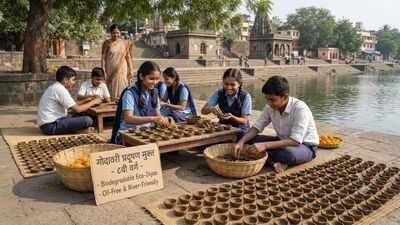
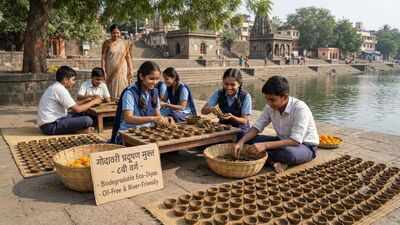
A simple festival ritual inspired Class 8 students to rethink how floating lamps affect the Godavari. Their oil-free, biodegradable diyas have now earned international recognition and a grant to take the idea further. What if a traditional diya could bring light to a river without leaving behind pollution?That question led a group of Class 8 students at Espalier The Heritage School in Nashik, Maharashtra, to rethink the way people offer floating lamps during religious celebrations. Instead of accepting the environmental cost of the ritual, the students decided to find a cleaner alternative that could preserve its meaning while protecting the river.Their idea, called A Diya for the River, A Light for Life, has now earned them a place among the winners of the inaugural I CAN Earthshot Challenge, a children’s environmental innovation programme. The team was recognised for creating biodegradable, oil-free diyas designed to reduce pollution in the Godavari. The achievement is a reminder that environmental solutions do not always begin in laboratories. Sometimes, they begin with children questioning something adults have long taken for granted.
A festival tradition, reimagined
In India, floating diyas in rivers is a cherished tradition associated with prayer, devotion and gratitude. However, when thousands of lamps are released into water bodies, the oil, leftover material and waste can become an environmental concern. The students recognised that the answer did not have to be abandoning the ritual altogether. Instead, they wanted to make it more responsible.Their diyas are made using food-based ingredients such as sabudana and rice flour, with camphor used in place of conventional oil. The aim is to create lamps that can break down naturally and leave behind less waste in the river. The project is particularly relevant to Nashik, where the Godavari is central to religious life and where large gatherings, including the upcoming Kumbh Mela, are expected to bring thousands of devotees to the riverbanks. The students’ idea offers a different way of looking at sustainability: protecting nature does not necessarily mean giving up traditions. It can also mean finding better ways to practise them.
From failed experiments to 200 diyas
The eco-friendly lamps did not come together overnight. The students spent around 15 to 30 days experimenting with different ingredients, testing materials and modifying their designs to make the diyas functional. Some attempts did not work as expected. According to reporting by Loksatta, a few lamps developed fungus, forcing the students to revisit their material combinations and improve the design.Rather than treating these setbacks as reasons to stop, the children used them to understand what needed to change. They continued experimenting until they could produce approximately 200 diyas. Of these, 100 were submitted to the authorities associated with preparations for the Kumbh Mela. The proposal was appreciated and accepted for consideration, opening up the possibility of the lamps being explored for wider use during river-related religious activities.The project has also reportedly reached around 1,000 people, with local vendors and priests helping spread awareness about the idea. For the students, this was no longer just a classroom activity. It was an attempt to take a solution beyond school walls and encourage people to rethink the waste their celebrations may leave behind.
A global award for a local idea
The students’ work earned them the winning title in the Revive Our Rivers, Lakes and Oceans category of the inaugural I CAN Earthshot Challenge, a nationwide initiative encouraging children to develop practical solutions to environmental problems. The award ceremony took place on November 17, 2026, at the Museum of Solutions in Mumbai. Prince William and Catherine, Princess of Wales, attended the ceremony, where five winning teams were recognised for their innovations. British actress and musician Simone Ashley presented an award.The Nashik team was among 15 finalist teams selected to participate in the Children’s Earthshot programme. The finalists came from across India and presented solutions addressing issues such as pollution, waste, water conservation, air quality and climate change. Each winning team receives a grant of US$2,000 to further develop its idea and expand its impact in the community. For the students, the recognition gives their river-friendly diya project an opportunity to move beyond a small batch of prototypes and reach more people.The challenge was organised by The Earthshot Prize in partnership with Brazilian philanthropic organisation Alana and the global youth movement Design for Change. The initiative reached nearly one million students across 15,000 schools in 24 Indian states, encouraging children aged 9 to 17 to move beyond awareness and take action.
When children become part of the solution
The most meaningful part of the Nashik students’ achievement may not be the award itself but the way they approached a problem close to their lives. They noticed that a tradition celebrated by thousands could also place pressure on a river. They questioned whether it could be done differently, experimented with materials, faced setbacks and created an alternative.Their biodegradable diyas are still a developing solution, and wider adoption will depend on further testing, practical use and community participation. But the project has already demonstrated something important: young people do not have to wait until adulthood to contribute to environmental change. A lamp may be small, but the idea behind it carries a larger message. Protecting the rivers we worship and depend on can begin with the choices we make during our celebrations. And sometimes, the people who show us how to make those choices better are still sitting in Class 8.