
After Relative Silence, Joe Rogan Said MAGA Has Lost the “Podcast Bros”
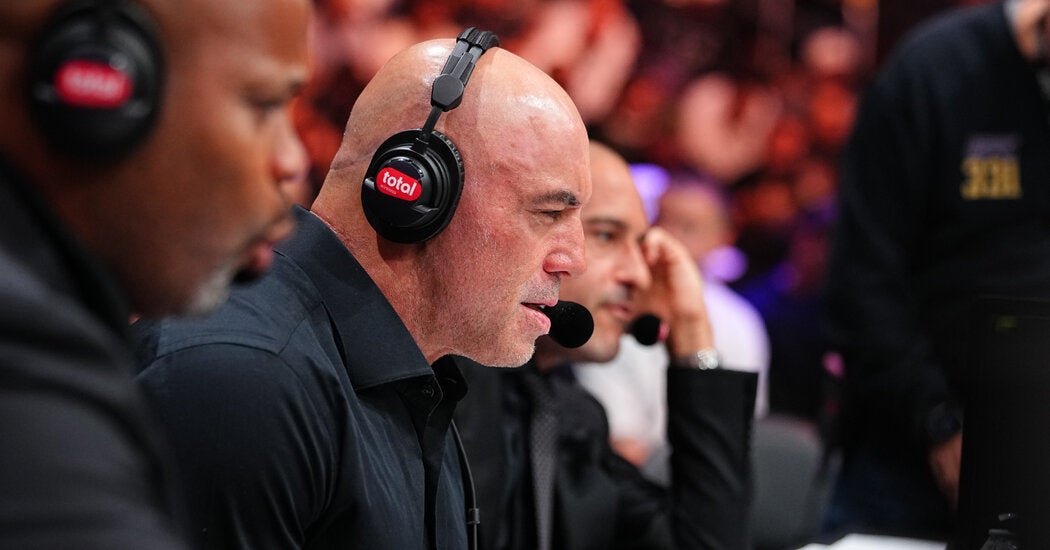
In the aftermath of the midterm wipeout for Republicans, Joe Rogan, the nation’s top podcaster, has not had a lot to say about politics, instead focusing his program on topics such as Hobbit-like hominids and dinosaurs, which he wanted to assure people were real.
But on Friday, Rogan, who endorsed Donald Trump in 2024 and was seen as crucial in his winning over young male voters, had a harsh assessment of the president’s policies, as well as, seemingly, his place among male podcasters like himself.
“They didn’t just lose the podcast bros,” Rogan said, during a discussion of Trump. “They lost most of the country.”
He continued, saying support had frayed when the Trump administration got “into a war that no one wants to be in,” referring to the war in Iran, and put “militarized police in the streets wearing masks,” a reference to the ongoing crackdown by Immigration and Customs Enforcement.
Rogan’s remarks came just two days after he expressed disgust at politics in another broadcast — “It’s all gross; I hate it,” Rogan said Wednesday, adding, “I don’t like politics at all” — and had largely avoided discussing the midterm elections.
His relative silence had been surprising given the level of influence he and other “manosphere” influencers were credited with in the 2024 election, when young men banked to the right to help carry Republicans to victory in what some called “the podcast election.”
Theo Von, another popular podcaster, who hosted Trump on his show in August 2024, had also been largely mute on the election. This week’s episode of his show, “This Past Weekend,” for instance, featured a happiness expert.
The same was true of Andrew Schulz, whose podcast, “Flagrant,” hosted the president just a month before the 2024 election, allowing him to attack President Biden about sleeping too much and praising Trump’s sense of humor.
Schulz’s shows since the 2026 election have been on other topics: oral sex after marriage and an episode entitled “What Hasidic Jews, Amish and Native Americans Know That We Don’t.”
In some ways, the manosphere’s seeming shift away from explicitly political content is a return to form for a coterie made up of comedians with wide-ranging curiosities and an audience that often just wants to be entertained.
But it also may mirror a broader shift occurring in the Make America Great Again movement. In September, The Wall Street Journal reported that conservative podcasters were “tuning out Trump,” in favor of other topics, including the Lindsay Clancy trial and the Senate candidacy of James Talarico, a young Democrat who won his campaign in Texas.
Initial data about the election also bore out a profound change of heart in young men, showing men ages 18-29, a prime audience for manosphere broadcasters, moving more than 30 points to the left, according to The New York Times’s estimates of voter trends. Male voters as a whole also moved left, some 17 points.
Clay Travis, a conservative broadcaster who often also discusses sports, another mainstay of some manosphere shows, suggested — like Trump himself did — that the election, and the attention paid to it by podcasters, came down to who was running.
“I can’t speak for those guys when it comes to their show decisions, but I think when Trump isn’t on the ballot the stakes feel far lower with most of the audience,” Travis said. “2016, 2020 and 2024 felt like existential battles over the fate of the country. The midterms feel like scrimmages in comparison.”
Some members of the manosphere have been uneasy about Donald Trump and Republicans for months, as the war dragged on. That included Rogan himself, who expressed shock in March after the United States and Israel launched their first attacks, at one point amounting it to a betrayal.
“It just seems so insane,” Rogan said. “He ran on no more wars: End these stupid, senseless wars. And then we have one.”
Von also started to question the motives for the war, telling Rogan in April that he was “sick of rich people not putting” their children “over in these wars.” He also said if simply obtaining oil was the goal, “I’d rather walk.”
Schulz had also been alienated from the Trump administration after the killing by federal agents of Alex Pretti, a nurse who was protesting an immigration crackdown in Minneapolis in January.
Some podcasters popular with young men had already spoken out about Nov. 3’s results. Tim Dillon, a sunglass-wearing comedian who has some 1.3 million YouTube subscribers, had already started to turn on the Trump administration, suggesting earlier this year that Trump was “obviously here to destroy Earth.”
And shortly after the election, Dillon jumped into the debate, discussing Trump’s reaction to his party’s losses (which he called “wistful”), while devoting an hour to a dissection of the midterms.
“I remember two years ago everybody was like, ‘Will the Democrats ever win another election?’” Dillon said, later adding that the results were easy to predict.
“People can’t buy things. They can’t own things,” Dillon said. “People in America exist in two states, broke or not broke.”
A battery of more resolutely conservative male influencers had been outspoken about the election, attacking the president and his party for big losses at the ballot box, with once-loyal social media surrogates voicing demands for change.
“The Trump chapter is finished,” said Matt Walsh, a right-wing pundit who has argued for a subservient role for women in society. “Trump is an extremely unpopular 80-year-old lame duck with no credibility with the voters, no future, and now, no real power.”
Other die-hard conservative podcasters such as Ben Shapiro, Michael Knowles and Steve Bannon were also critical of Republicans, with Bannon predicting a “civil war” inside the party.
Some manosphere figures even linked the Republican losses to the party’s position on men.
“A party that hates its own men is destined to lose,” said Myron Gaines, an influencer who has frequently made anti-female and anti-gay remarks, in a lengthy, 10-point treatise he posted on X shortly after the results came in.
“Men built this country,” Gaines wrote, “and they are not the enemy.”
Pollsters like Gallup have grouped Rogan into “right-leaning influencers,” alongside the likes of Tucker Carlson, the formerly avid Trump supporter who has broken hard with the president over the war in Iran.
After the election, Rogan had made a few passing comments on the results. In an interview last week with Calley Means, a former adviser to Health Secretary Robert F. Kennedy Jr. and a leader of the Make America Healthy Again movement, Rogan said that Republicans “got destroyed” in the midterms, noting that some of the president’s policies were “deeply unpopular.”
But his remarks on Friday went further, noting the war and an immigration crackdown he said went too far, targeting “nice, good people that are loved by the community but they just don’t have the right paperwork.”
He did praise certain elements of the Trump agenda, saying that “they closed the border and then crime dropped significantly. Those are good things.”
But Rogan, who signed a deal with Spotify reportedly worth up to $250 million in 2024, also seemed bothered by being grouped in with right-wing influencers, after being asked by another guest what he was “angry about.”
“A lot of it is people that don’t really listen to you: They just listen to a narrative about you or they listen to a clip,” Rogan said on Friday, adding that “in a lot of people’s eyes, I represent the right or the far right.”
At the same time, he also downplayed his influence, and seemingly that of other podcasters, saying that they are not “press people.”
“It’s a sickness of our society,” he said, “that people take our opinions so importantly.”