

Four ways in which government can look to abolish LTCG tax for all class of investors; what SBI report says


The State Bank of India (SBI) in its recent research report has listed ways in which the government can look at doing away with the long term capital gains (LTCG) tax without taking a major hit on its revenue collections.The stock market had generated returns of around 30% in the preceding financial year, leading foreign investors to book profits during FY25.The market situation has since changed considerably. SBI Research pointed out that the Nifty’s average return over the past three years was only 0.5%, while foreign institutional investors had collectively withdrawn Rs 4.8 lakh crore from Indian markets.The potential impact on market activity is another important consideration for doing away with LTCG, it says.A complete removal of LTCG tax could encourage higher market turnover after a specified period, even if the STT rate remained unchanged. STT collections are currently estimated at around Rs 73,000 crore for FY27. These receipts could rise in the coming years even if changes to LTCG taxation are introduced gradually.
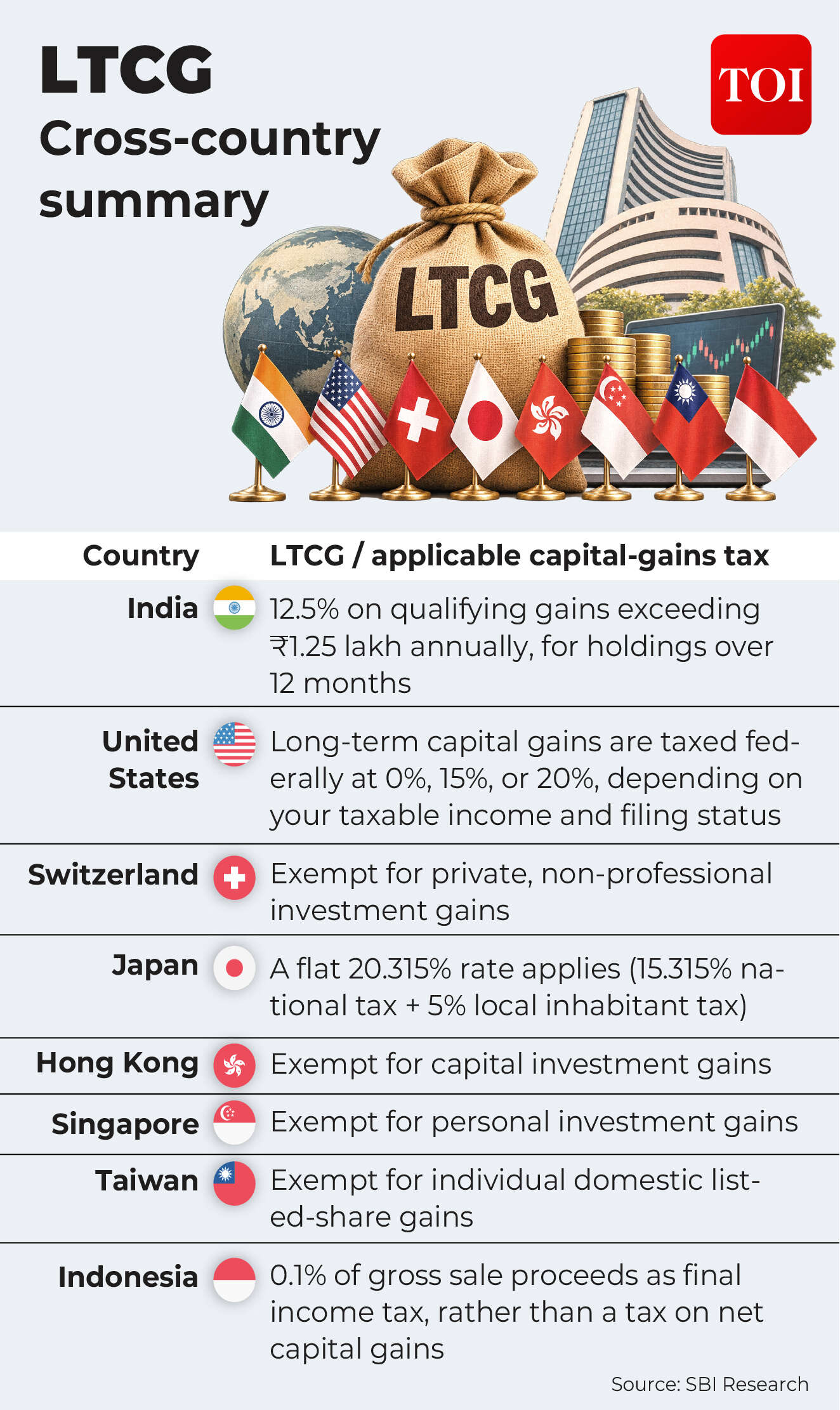
LTCG: Cross-country summary
How LTCG should be abolished
According to SBI Research, there are several possible ways to restructure LTCG taxation.First, the exemption limit could be revised to account for the expansion of the retail investor base. Rather than retaining a fixed threshold, currently set at Rs 1.25 lakh, the government could consider linking it to inflation. This would help ensure that the exemption keeps pace with rising prices.Second, investors holding assets for longer periods could receive more favourable tax treatment. For instance, LTCG tax could be reduced to zero for investments held for more than two to three years, compared with the current rate of 12.5% applicable to holdings of one to two years.Third, any review of LTCG taxation could be accompanied by an increase in the securities transaction tax (STT). A 50% increase in STT could generate additional revenue of around Rs 45,000 crore in FY28. Introducing a tiered LTCG tax structure could also bring in further revenue.Fourth, the government could consider allowing investors to defer LTCG tax on mutual fund redemptions in proportion to the proceeds reinvested in eligible equity mutual funds within 90 days. A similar approach is available for property sales. Such a provision could help investors move their money from mutual funds delivering lower returns to funds offering more reasonable returns.
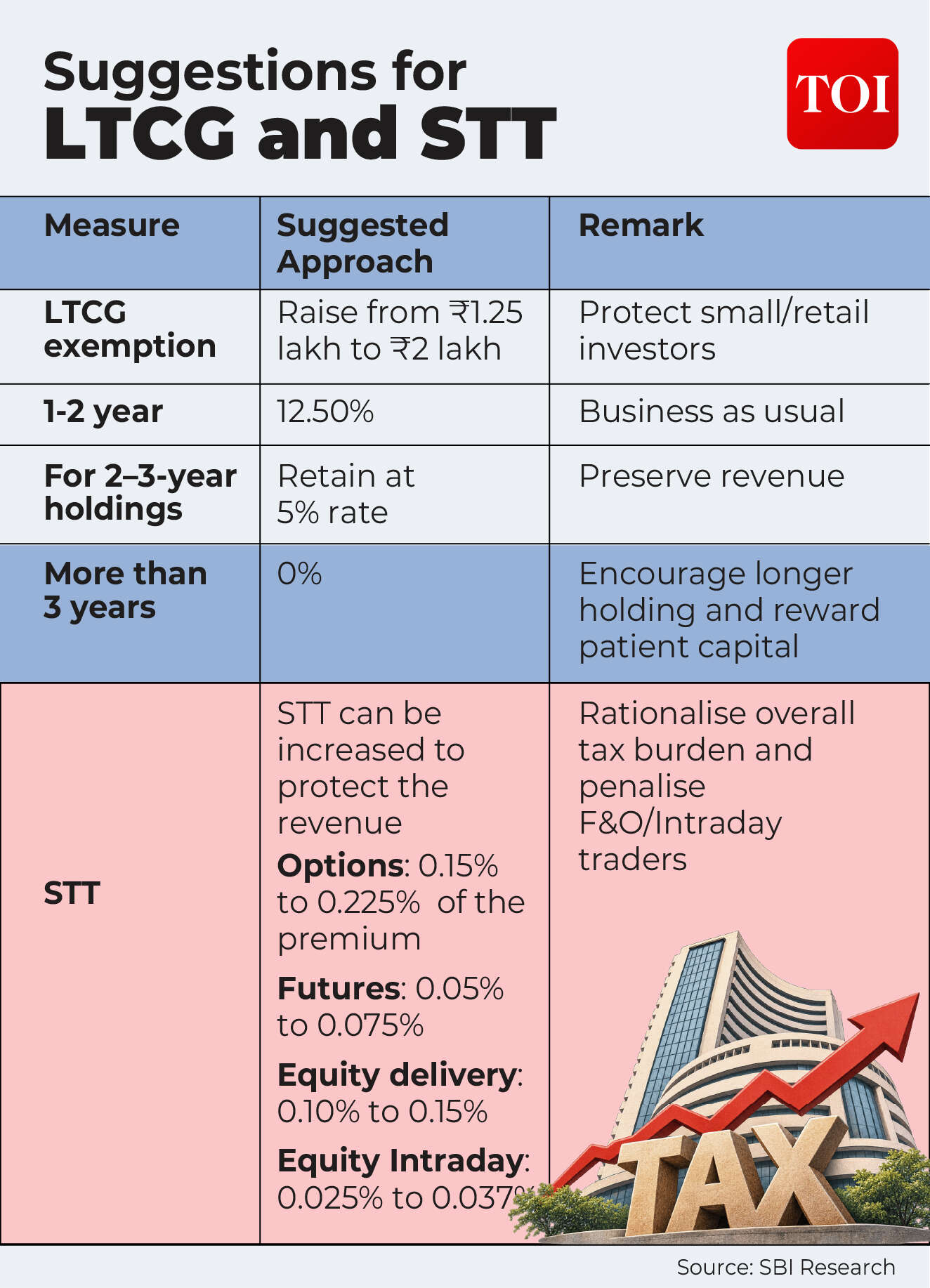
Suggestions for LTCG and STT
Revenue hit for government
According to SBI Research, the government could do away with long-term capital gains tax for all categories of investors without majorly affecting its fiscal consolidation targets.The SBI report estimates a revenue loss of Rs 40,000-50,000 crore in FY28, if LTCG tax is abolished.SBI Research assessed that eliminating LTCG tax would result in a revenue shortfall equivalent to just 0.1-0.2% of GDP. It said the government could accommodate this impact without moving away from its fiscal glide path.The research report put LTCG tax collections at approximately Rs 1 lakh crore in FY26, with receipts expected to fall further to Rs 40,000-50,000 crore in FY27.
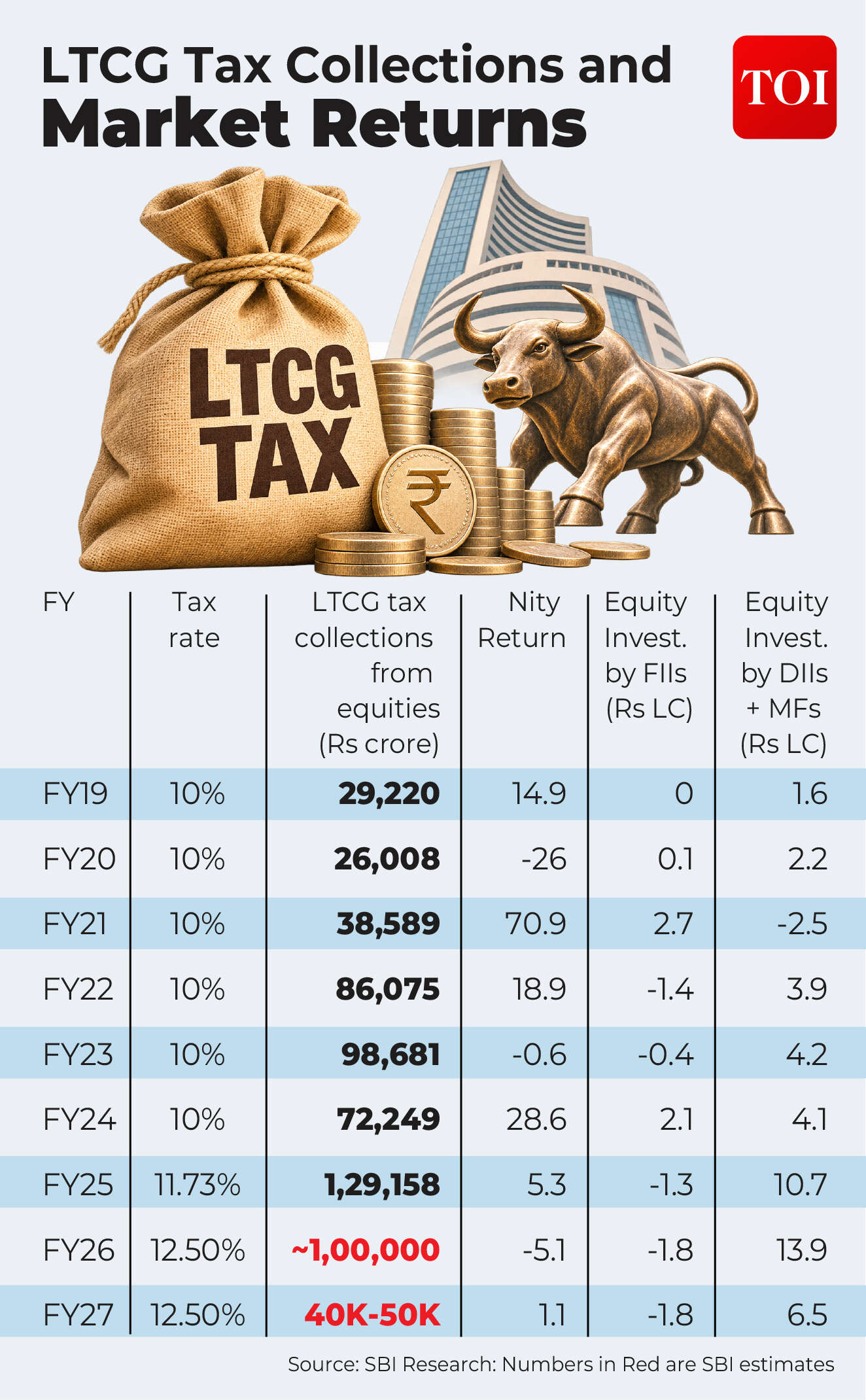
LTCG Tax Collections and Market Returns
The collection of Rs 1.3 lakh crore recorded in FY25, it said, was an exception rather than a reflection of the prevailing trend.“We believe the government would be able to take this hit if hypothetically, the entire capital gains taxes were abolished,” the report said.SBI Research had originally put forward the proposal to abolish LTCG tax in its October 12 edition of Ecowrap. It argued that removing the levy could help bring foreign capital back into Indian markets and improve investor confidence at a time when foreign portfolio investors (FPIs) have been consistently withdrawing money from domestic equities.The report had also recommended offering favourable tax treatment to investments held for two to three years. Such a move, it said, could encourage investors to commit capital for longer periods and make Indian equities a more attractive destination for global funds.