

Beyond oil & gas: How Middle East conflict impacts India – from gold & diamonds to aircraft & fertilizers
The Middle East conflict has brought into focus the vulnerability of countries around the world in terms of their dependency on oil and gas. India, the world’s fifth largest economy, is also the third largest importer of oil. A big portion of its gas needs – LPG and LNG – is also dependent on imports routed via the Strait of Hormuz. Additionally crude oil prices climbing above $100 per barrel have also led to shockwaves globally – and India is also expected to see a hit on its current account deficit as the oil import bill rises.But beyond oil and gas, several other sectors of the economy will likely see a hit if the US-Iran war continues for a longer duration.
According to Barclays, India’s non-energy imports from the Middle East are sizable as well – at approximately 10% of total non-energy imports. “Middle East’s position in global trade goes beyond energy, with material but underappreciated exposures across chemicals, construction, agriculture and basic manufacturing,” says Barclays India in a report. However it notes that the starting point for the Indian economy, whether it is in terms of GDP growth, inflation, external and fiscal balances, is quite robust. This offers enough headroom, going into this price and supply shock from the ongoing conflict in the Middle East, it says.
Beyond oil & gas: Which sectors of Indian economy are vulnerable?
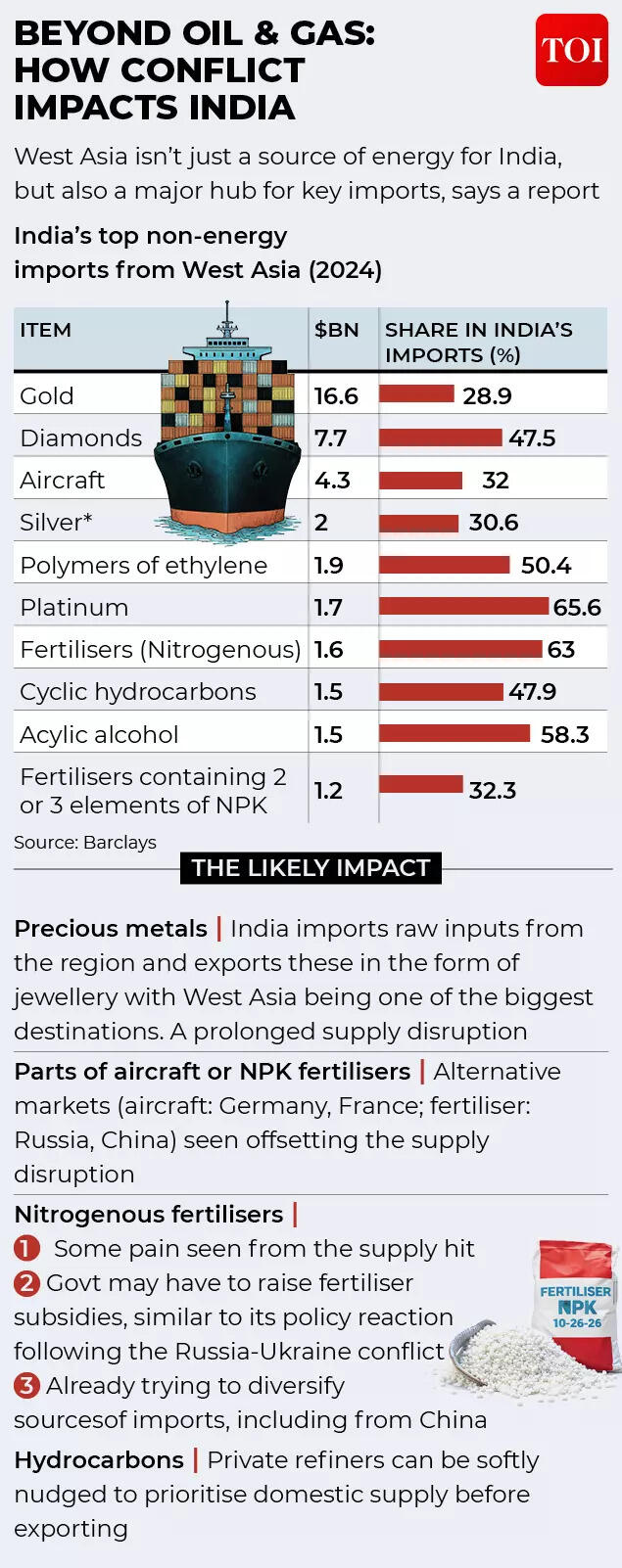
As Barclays points out: 10% of India’s non-energy imports in 2024 originated from the Middle East region. The research report finds that the dependency is particularly higher for imports of diamonds (47.5% of India’s total imports come from the Middle East), fertilisers (63%), polymers (50%) and hydrocarbons (48%)!Also Read | India’s Goldilocks under threat? How US-Iran war, crude oil above $100 may deal a blow to growth story – explainedThe Middle East plays an important role in global trade that extends well beyond energy supplies. The region also has significant, though often underestimated, influence across sectors such as chemicals, construction materials, agriculture and basic manufacturing.While India’s reliance on energy shipments from the Middle East is well known, its dependence on non-energy imports from the region cannot be ignored. Countries including Iran, Saudi Arabia, Israel, Iraq, Qatar, United Arab Emirates, Oman, Kuwait, Bahrain accounted for roughly 10% of India’s total non-energy imports in 2024.
How Middle East conflict impacts India beyond oil & gas
Not only that, in some sectors such as precious metals including gold, diamonds, platinum and silver, India typically imports raw materials and processes them domestically before exporting finished jewellery. Since the Middle East is also a major destination for these exports, any extended disruption to imports caused by the conflict could also affect India’s export activity in these products.For other sectors, such as aircraft components and NPK fertilisers, Barclays is of the view that alternative sources can help offset some supply disruptions. Countries outside the Middle East such as Germany and Paris for aircraft parts, and Russia and China for fertilisers, together account for a larger share of India’s imports in these categories. Assuming these partners have the capacity to expand trade with India, they could potentially help bridge any shortfall arising from reduced Middle Eastern supply, the research report says.Barclays sees ‘some pain’ from the hit to the supply of nitrogenous fertilisers (63% dependency on Middle East), given the share of second/third largest partners lag way behind (Russia: 22%, China: 5%). “If the supply disruption prolongs, leading to a surge in international prices, the government may have to raise fertiliser subsidies, similar to its policy reaction following the Russia-Ukraine conflict. However, media reports indicate the government is already trying to diversify sources of imports, including from China,” Barclays notes.In the hydrocarbons sector, private refiners could potentially be encouraged to prioritise domestic supply over exports if needed, which would help soften the impact of reduced external imports. “In sum, beyond the energy dependence, India’s dependence on the Middle East can be met via alternate sources and/or redirecting domestic production for domestic consumption, before exports,” it concludes.